29 Integrating complex submodels
Finally, after much of the modelling equivalent of blood and sweat, we reach the point where we can combine the contribution of all our modules with the full implementation of the Pond Trade model (step 13).
29.1 Integrating module 4 (ARID) and 5 (routes)
We use module 4 (ARID) as the starting template and add import-routes-from-file and all route-related procedures. We should be able to import the route data saved before and load it during setup, as the last step before setup-patches:
globals
[
  ...

  routes

  ...
]

...

to setup

  clear-all

  ; --- loading/testing parameters -----------

  import-map-with-flows ; import-world must be the first step

  set-constants

  set-parameters

  import-routes-from-file

  ; --- core procedures ----------------------

  set currentYear weatherInputData_firstYear
  set currentDayOfYear 1

  ;;; values are taken from input data
  set-day-weather-from-input-data currentDayOfYear currentYear

  ask patchesWithElevationData [ update-WAT ]

  ; --- display & output handling ------------------------

  update-output

  refresh-view

  paint-routes

  ; -- time -------------------------------------

  reset-ticks

end

...

to refresh-view

  ...

  paint-routes
  paint-active-routes

end


to paint-routes

  ;;; define list of shades of red in NetLogo
  let redShades (list 11 12 13 14 15 16 17 18 19)
  ;;; NOTE: this is needed because RGB colours based on elevation are a list
  ;;; while NetLogo color are numbers

  ; resets route patches to the terrain color
  foreach routes
  [ ?1 ->
    let aRoute ?1

    foreach aRoute
    [ ??1 ->
      ask ??1 [ display-elevation ]
    ]
  ]

  ; paint route patches in shades of red depending on route frequency
  foreach routes
  [ ?1 ->
    let aRoute ?1

    foreach aRoute
    [ ??1 ->
      ask ??1
      [
        if (showRoutes)
        [
          ifelse (not member? pcolor redShades) ; if it's the first route crossing the patch
          [
            set pcolor 11
          ]
          [
            set pcolor min (list (pcolor + 1) (19)) ; sets a maximum at 19 (the brightest)
          ]
        ]
      ]
    ]
  ]

end

to paint-active-routes

  ask traders
  [
    foreach route
    [ ?1 ->
      ask ?1
      [
        ifelse (showActiveRoutes)
        [
          set pcolor yellow
        ]
        [
          if (not showRoutes) ; if not displaying all routes
          [
            ; resets to the patch terrain color
            display-elevation
          ]
        ]
      ]
    ]
  ]

end
29.2 Integrating Pond Trade (step 13)
Next, bring in all the extra code and interface objects from Pond Trade (step 13). Most procedures require no modifications. The exceptions are:
- There is no
isLandvariable here and, given that there are no water patches, we should simply erase the code that distinguishes it. - Since there are only land patches and we are using the standard deviation of elevations to assign
pathCost, there are norelativePathCostInLandorrelativePathCostInPort. We can remove all references to these two parameters, leaving the corresponding cultural traits of transport technology as the sole modifiers ofpathCost.
We carefully organise the scheduling of calls in setup and go:
to setup

  clear-all
  reset-ticks

  ; set the random seed so we can reproduce the same experiment
  random-seed seed
  set patchesCount count patches

  create-map

  create-coastal-settlements

  set-routes

  create-traders-per-settlement

  update-output

  update-display

  update-plots

end

...

to go

  tick

  if (ticks = 10000 or count turtles > 500) [ stop ]

  update-traders

  update-settlements

  update-output

  update-display

end
29.3 ARID as a factor of settlement productivity
Finally, we connect ARID to settlement productivity.
First, we calculate two new settlement variables: catchmentArea and ARIDinCatchmentArea. The latter is the average ARID within the settlement catchment area. In turn, the catchment area is calculated using a gradient decay function, dependent on sizeLevel and two parameters, catchmentSlope and catchmentRadiusMaximum. This is a very preliminary solution, but will suffice for us to observe the dynamics of Pond Trade playing out over the Messara Valley.
settlements-own
[
  ...
  catchmentArea
  ARIDinCatchmentArea
]

...

to update-settlements

  ask settlements
  [
    let thisSettlement self

    ; the sizeLevel of settlements decays at a constant rate, up to 1 (minimum)
    set sizeLevel max (list 1 (sizeLevel * (1 - ((item 5 culturalVector) / 100)) ) )
    ; production in stock also decays at a constant rate
    set stock stock * (1 - ((item 6 culturalVector) / 100))
    ; production is generated in proportion to sizeLevel, following a constant rate and the average ARID within the settlement catchment area
    update-ARIDinCatchmentArea
    update-catchmentArea
    set stock stock + sizeLevel * ((item 7 culturalVector) / 100) * ARIDinCatchmentArea

    ...
  ]

end

...

to update-ARIDinCatchmentArea

  let patchesInCatchmentArea patches in-radius catchmentArea

  ifelse (count patchesInCatchmentArea = 1)
  [ set ARIDinCatchmentArea [ARID] of patch-here ]
  [ set ARIDinCatchmentArea mean [ARID] of patchesInCatchmentArea]

end

to update-catchmentArea

  set catchmentArea get-value-in-gradient sizeLevel catchmentSlope catchmentRadiusMaximum

end

to-report get-value-in-gradient [ input gradient maximum ]

  report e ^ ( - input / ((gradient / 100) * maximum) )

end
And voilà! We can now run our boosted Pond Trade model within the context of our case study.
29.4 Checking the milestone File (module 6)
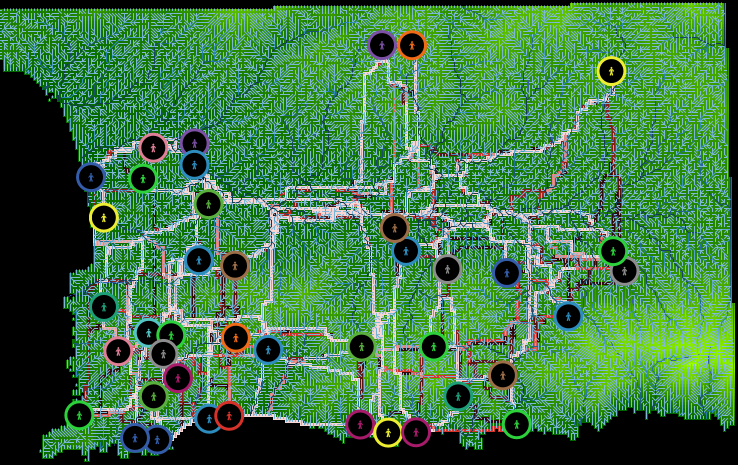
View of MesaraTrade after setup
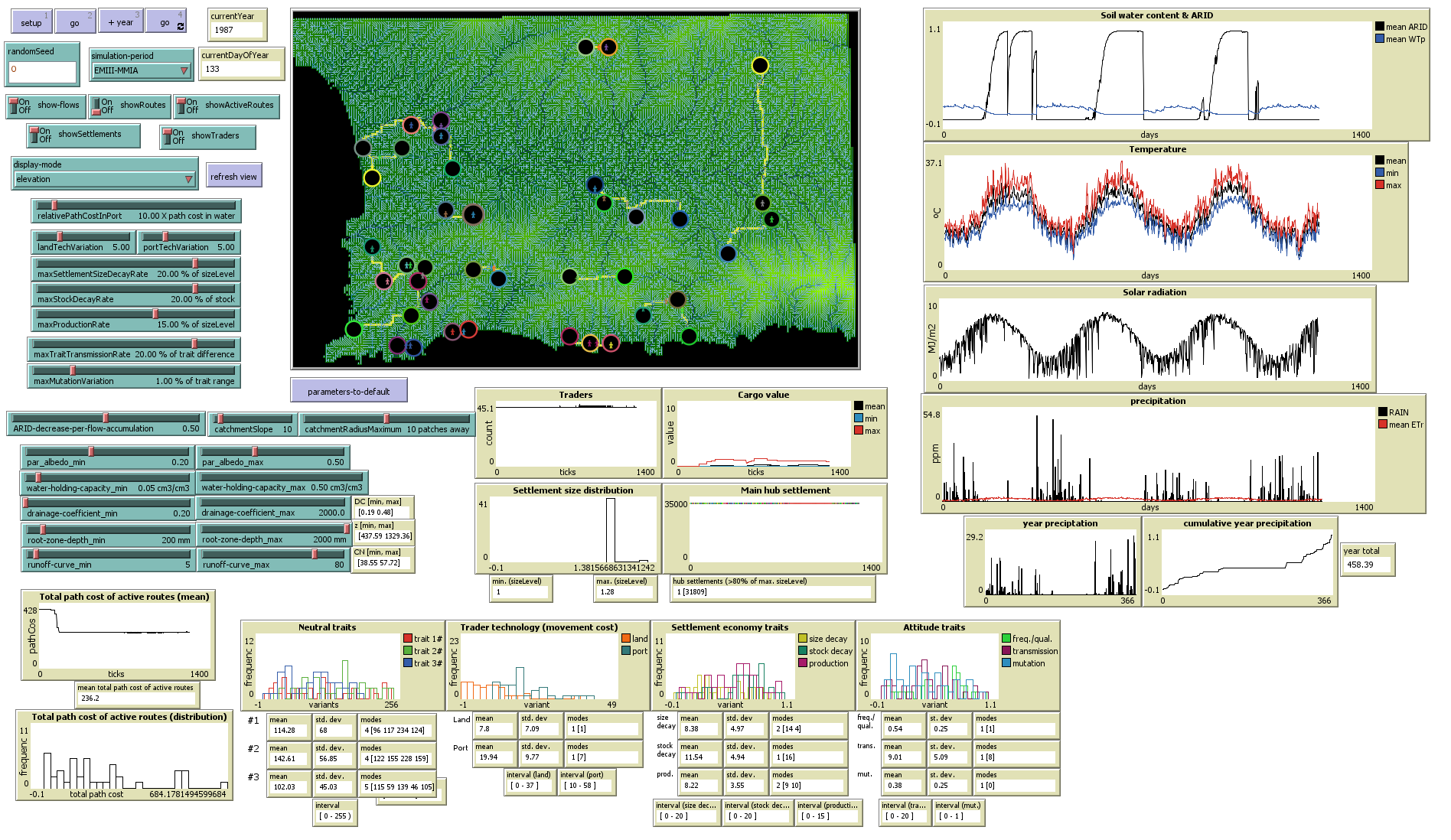
View of MesaraTrade interface
Run the model for a few years using the default configuration. Observe trader behaviour and the overall dynamics of settlement size and trade between them. Is there something off about how the new version is running?
Think about the case study and the mechanisms targeted by the original Pond Trade model. What aspects do you find problematic?