19 Implementing mechanisms
We now reach the “spicy” part of Pond Trade’s development. Until this point, settlements are entirely static, and traders are created only in setup, then travel back and forth without affecting settlements.
Remember that the core dynamics of the first-tier conceptual model consisted of two overlapping feedback loops. It could be decomposed as:
- Settlements produce goods, and they decay over time.
- Traders choose destination✅, load, move✅ and unload goods.
- Settlements’ size increases with goods and decays otherwise.
- Settlements get more or fewer traders depending on their size.
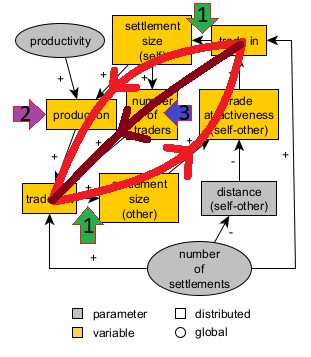
The loops of the first-tier conceptual model and its key implementation points
19.1 Implementing one feedback loop - trade and economic size 🤔
First, implement the general feedback loop described in the conceptual model, connecting settlement size and trade flow.
Before looking at the solution, try to write the code yourself:
- Traders load and unload goods at the base and destination settlements (use a variable:
cargoValue) - Settlements increase their size with goods coming by trade
- Reorganise the behaviour of traders inside a
update-tradersprocedure
- Settlement size decays over time, down to a minimum size of 1 (use a parameter:
settlementSizeDecayRate)
Things to consider:
- When should traders load and unload goods?
- How to increase settlement size based on goods?
- How to decrease settlement size over time?
Solution:
Let us reorganise the behavioural cycle of traders into a new separate procedure, update-traders:
to update-traders

  let tradersInBase traders with [is-in-base]
  let tradersInDestination traders with [is-in-destination]

  ; UPDATE LAST POSITION
  ask traders
  [
    ; update lastPosition if in a patch center
    if ((xcor = [pxcor] of patch-here) and (ycor = [pycor] of patch-here))
    [
      set lastPosition patch-here
    ]
  ]

  ; UNLOAD
  ask (turtle-set tradersInBase tradersInDestination) with [cargoValue > 0]
  [
    ; unload cargo (changes sizeLevel)
    unload-cargo
    ; load cargo (changes stock)
    load-cargo
  ]

  ; CHOOSE DESTINATION
  ask tradersInBase
  [
    ; update the destination whenever in the base settlement and there is cargo to transport
    choose-destination
  ]

  ; FIND DIRECTION in route
  ask (turtle-set tradersInBase tradersInDestination)
  [
    find-direction
  ]

  ; MOVE towards the next position in the route
  ask traders
  [
    ; move following the route when there is cargo to transport
    move-to-destination
  ]

end

to choose-destination ; ego = trader

  let thisTrader self

  ; get routes connecting the base settlement
  let routesFromBase get-routes-to-settlement [base] of thisTrader

  ; order these routes by benefit/cost ratio
  set routesFromBase sort-by [ [?1 ?2] -> benefit-cost-of-route ?1 > benefit-cost-of-route ?2 ] routesFromBase

  ; print the options available
;  foreach routesFromBase
;  [
;    print "==============================================================="
;    print "route between:"
;    print [who] of get-origin-and-destination ?
;    print "has the benefit-cost ratio of:"
;    print benefit-cost-of-route ?
;  ]
;  print "-x-x-x-x-x-x-x-x-x-x-x-x-x-x-x-x-x-x-x-x-x-x"

  ; select the one with higher benefit/cost ratio
  set route first routesFromBase

  ; get the settlement of destination
  set destination one-of (get-origin-and-destination route) with [who != [who] of ([base] of thisTrader)]

end

to find-direction ; ego = trader

  ; find where in the route list the trader is
  let currentPosition position lastPosition route

  ; set direction if in a settlement
  ifelse (currentPosition = 0) ; in the first extreme of the route list
  [
    ; move in the route list towards larger index numbers
    set direction 1
  ]
  [
    if (currentPosition = (length route - 1)) ; in the last extreme of the route list
    [
      ; move in the route list towards smaller index numbers
      set direction -1
    ]
  ]
  ; else the trader is in route to either the base or the destination

end

to move-to-destination ; ego = trader

  ; find where in the route list is the trader
  let currentPosition position lastPosition route

  ; move through the route following direction
  let targetPatch item (currentPosition + direction) route
  ;move-to targetPatch ; constant travel time (1 patch per tick)
  facexy ([pxcor] of targetPatch) ([pycor] of targetPatch)
  forward min (
    list
    (1 / [pathCost] of patch-here) ; the maximum distance in a tick in the current patch
    (distancexy ([pxcor] of targetPatch) ([pycor] of targetPatch)) ; the distance to the target patch
    )

end

to-report is-in-base ; ego = trader

  report (xcor = [xcor] of base) and (ycor = [ycor] of base) ; if the trader arrived at the center of the base patch

end

to-report is-in-destination ; ego = trader

  report (xcor = [xcor] of destination) and (ycor = [ycor] of destination) ; if the trader arrived at the center of the destination patch

end
Notice that we refactor the previous code, splitting the former procedures into several more specialised parts.
We then define the new procedures to handle the interaction between traders and settlements:
traders-own [ base route destination direction lastPosition cargoValue ]

...

to unload-cargo ; ego = trader

  let thisTrader self
  let settlementHere one-of settlements-here

  ; unload cargo
  ask settlementHere [ add-trade-effect [cargoValue] of thisTrader ]

end

to load-cargo ; ego = trader

  let settlementHere one-of settlements-here

  ; load cargo
  set cargoValue [sizeLevel] of settlementHere

end

to add-trade-effect [ value ] ; ego = settlement

  set sizeLevel sizeLevel + value

end
We define a very simple “submodel” in which the economic size units of one settlement produce an equivalent amount of transportable value (cargoValue), which traders transfer to another settlement, again as economic size units. However, under this mechanism, we increase the economic size of settlements on every trader trip but never decrease it. To avoid this, we must specify a second mechanism that “decays” economic size over time, up to an arbitrary baseline value (i.e., 1).
For now, we implement this mechanism directly inside the go procedure, where we also call update-traders:
to go

  tick

  update-traders

  ; the size of settlements decays at a constant rate, up to 1 (minimum)
  ask settlements
  [
    set sizeLevel max (list 1 (sizeLevel * (1 - (settlementSizeDecayRate / 100)) ) )
  ]

  update-display

end
We must add another parameter to the interface to regulate decay: settlementSizeDecayRate (0 to 25, in steps of 0.01; default 5). This is the percentage of sizeLevel subtracted at each simulation step.
19.2 Visualising dynamics
To better explore the effects of this feedback loop, add plots to the interface. Select Plot in the drop-down menu and add two plot objects, as you have done with buttons, sliders, etc. Configure them as follows:
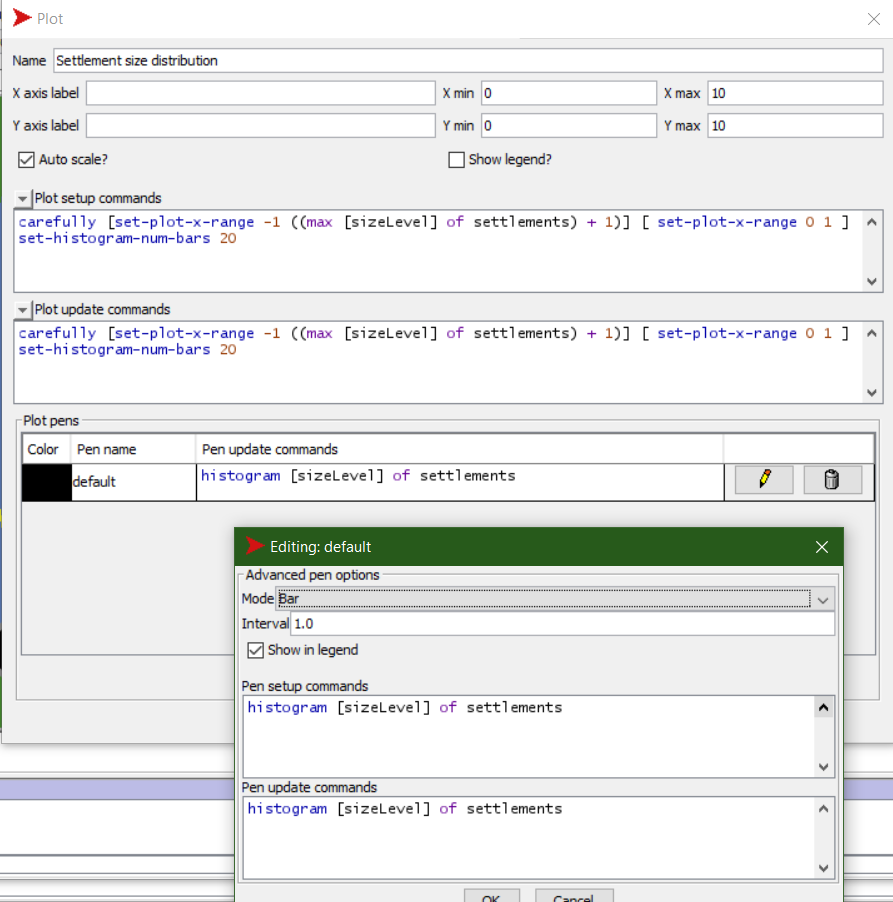 |
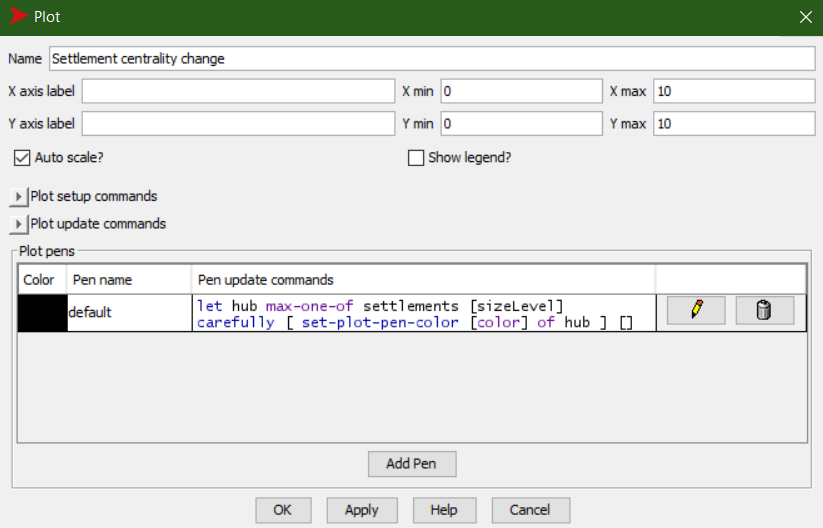 |
19.3 Checking the milestone File (step 8)
We can now run the model with a few settlements and repeat go many times. Explore different seed numbers. Are settlements reacting to traders’ dynamics at all? Is the value of settlementSizeDecayRate too high or low? What are we doing wrong?
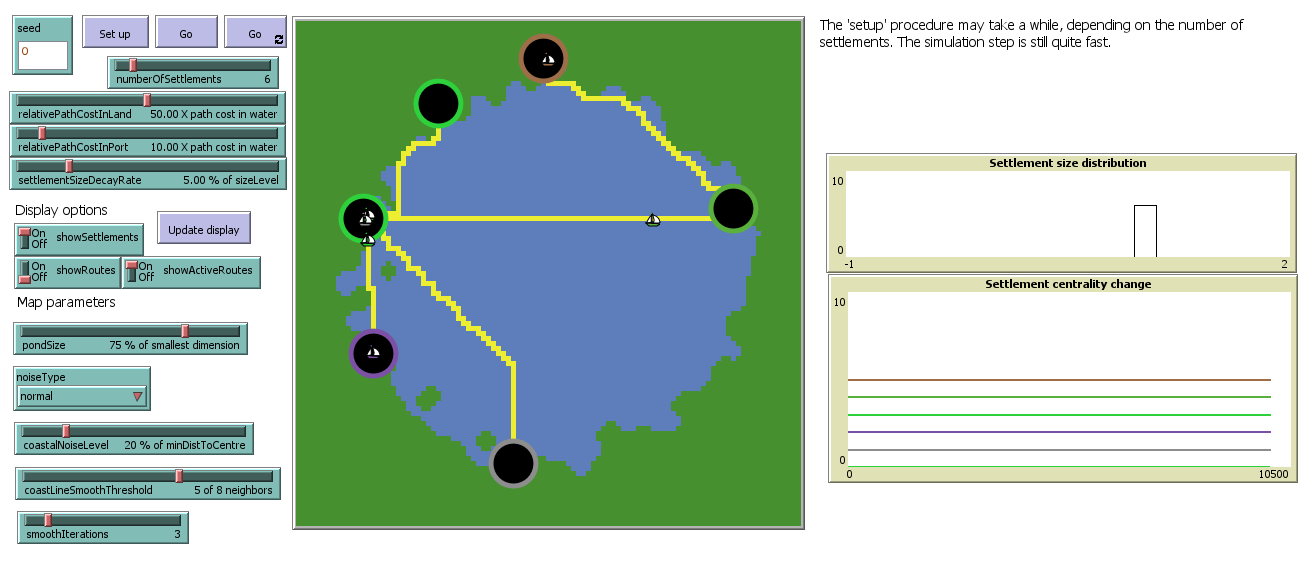
Pond Trade step 8
19.4 Detecting and correcting mistakes 🤔
Before moving to the second feedback loop, we must solve our problem.
Use inspect and printing commands to debug the model.
Can you tell what is wrong with the model behaviour?
Solution:
If you followed any of the different debugging approaches (e.g., inspecting agents, printing messages mid-code), you have detected that traders aren’t transporting any cargo value. The problem lies in how we scheduled the calls to unload-cargo and load-cargo. Notice that we added load-cargo to a conditional call ask (turtle-set tradersInBase tradersInDestination) with [cargoValue > 0], which is only relevant to traders with cargo, which is impossible for traders to fulfil initially.
We reorganise update-traders as follows:
to update-traders

  ...

  ; UNLOAD
  ask (turtle-set tradersInBase tradersInDestination) with [cargoValue > 0]
  [
    ; unload cargo (changes sizeLevel)
    unload-cargo
  ]

  ; LOAD
  ask (turtle-set tradersInBase tradersInDestination)
  [
    ; load cargo (changes stock)
    load-cargo
  ]

  ...

end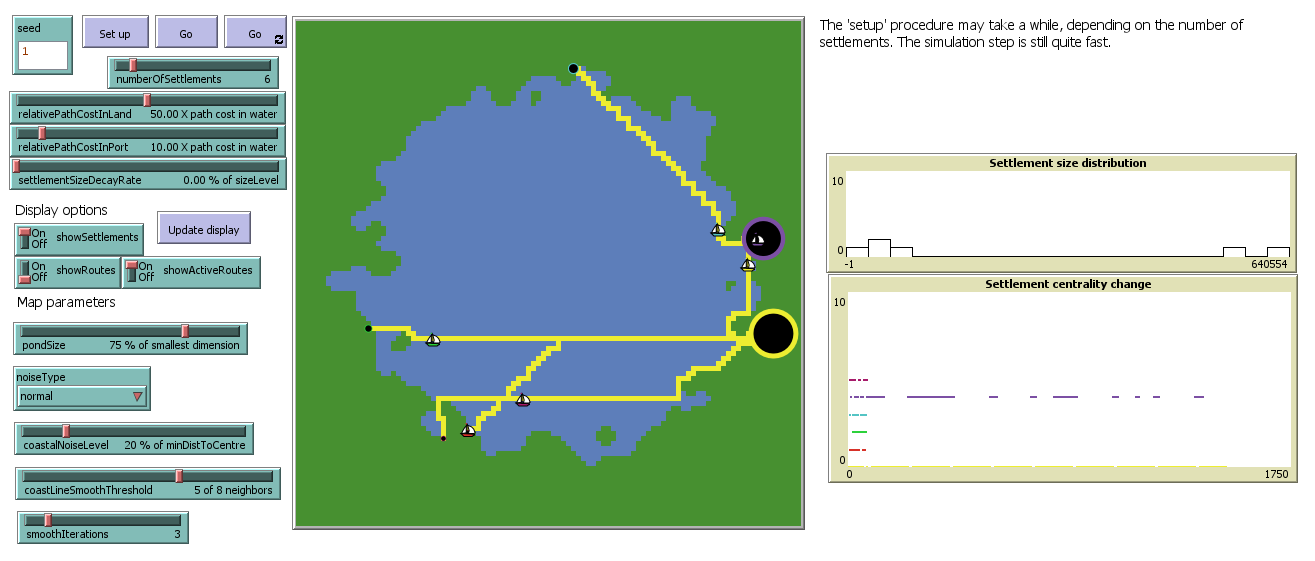
Pond Trade step 8 (after correction)
We can now see how, quite often, one or very few hubs emerge among settlements.
19.5 Implementing two feedback loops - trade-production and trade-number of traders 🤔
We split the general positive feedback loop into two, as specified in our concept model. These represent how trade flow affects settlement size through changes in the stock of goods and the number of traders per settlement.
Before looking at the solution, try to write the code yourself (medium-to-hard challenge):
- Settlements produce goods every tick in proportion to their size (use a parameter:
productionRate; use variables:sizeLevel,stock)
- The number of traders per settlement increases with settlement size (use variables:
currentNumberOfTraders,potentialNumberOfTraders)
- Reorganise the behaviour of settlements inside a
update-settlementsprocedure
Things to consider:
- How to increase the stock of settlements over time?
- How to calculate the potential number of traders?
- How to create new traders when needed? How to remove them?
Solution:
The key addition is that now we will have to differentiate, for each settlement, between currentNumberOfTraders and potentialNumberOfTraders, and update these according sizeLevel. To wrap this up, we implement an update procedure specifically for settlements (update-settlements).
We also need to manage traders left outside the maximum value for their base settlement. We create the tag isActivated to avoid creating and deleting too many traders in the same simulation run (i.e., it might become a problem as who numbers grow).
settlements-own
[
  sizeLevel
  currentNumberOfTraders potentialNumberOfTraders
]

traders-own
[
  isActivated
  base route destination direction lastPosition
  cargoValue
]

...


to create-traders-per-settlement

  ask settlements
  [
    let thisSettlement self ; to avoid the confusion of nested agent queries

    set potentialNumberOfTraders get-potential-number-of-traders

    hatch-traders potentialNumberOfTraders ; use the sizeLevel variable as the number of traders based in the settlement
    [
      setup-trader thisSettlement
    ]

    set currentNumberOfTraders get-current-number-of-traders
  ]

end

to setup-trader [ baseSettlement ]

  set base baseSettlement
  set isActivated true

  ; give meaningful display related to base
  set shape "sailboat side" ; import this shape from the library (Tools > Shape editor > import from library)
  set color [color] of base
  set size 3

  choose-destination

end

...

to update-settlements

  ask settlements
  [
    let thisSettlement self

    ; the sizeLevel of settlements decays at a constant rate, up to 1 (minimum)
    set sizeLevel max (list 1 (sizeLevel * (1 - (settlementSizeDecayRate / 100)) ) )

    ; determine the current and potential number of traders
    set currentNumberOfTraders get-current-number-of-traders
    set potentialNumberOfTraders get-potential-number-of-traders

    ; conditions favour the creation of new traders
    if (random-float 1 > currentNumberOfTraders / potentialNumberOfTraders )
    [
      ; create a new trader or activate an old one
      repeat 1
      [
        ifelse (any? traders with [not isActivated])
        [
          ask one-of traders with [not isActivated]
          [
            setup-trader thisSettlement
            move-to thisSettlement
          ]
        ]
        [
          hatch-traders 1
          [
            setup-trader thisSettlement
          ]
        ]
      ]
      set currentNumberOfTraders get-current-number-of-traders ; update currentNumberOfTraders
    ]
  ]

end

to update-traders

  ...

  ; UNLOAD
  ask (turtle-set tradersInBase tradersInDestination) with [cargoValue > 0]
  [
    ; unload cargo (changes sizeLevel)
    unload-cargo
  ]

  ; CHECK if the trader can be sustained when in the base
  ask tradersInBase
  [
    if ([potentialNumberOfTraders < currentNumberOfTraders] of base)
    [
      ; the current number of traders cannot be sustained
      set isActivated false
      ; update currentNumberOfTraders of base
      ask base [ set currentNumberOfTraders get-current-number-of-traders ]
    ]
  ]

  set activeTraders traders with [isActivated] ; update active traders
  set tradersInBase tradersInBase with [isActivated] ; update traders in base

  ; LOAD
  ask (turtle-set tradersInBase tradersInDestination)
  [
    ; load cargo (changes stock)
    load-cargo
  ]

  ...

end

...

to-report get-potential-number-of-traders ; ego = settlement

  report (
    1 +
    (sizeLevel - 1)
    )

end

to-report get-current-number-of-traders ; ego = settlement

  let thisSettlement self
  report count traders with [isActivated and base = thisSettlement ]

end
Settlements will now calculate potentialNumberOfTraders at every simulation step as a number equal to their size and will be allowed to create/reactivate or deactivate any traders accordingly.
Add a new Plot to visualise the count of traders through time, using the update command: plot count traders with [isActivated]
Our second feedback loop is now up and running!
However, our implementation is still rough around the edges and needs some refactoring and model extensions.
The production process is overly simplistic. Since there is no separate entity for sizeLevel, the production value is immediately replaced after traders load their cargo. We must introduce a new settlement variable, stock, to keep track of the flow of economic value and implement a more explicit representation of production and value decay, independent of size decay. For this, we introduce two new parameters, productionRate and stockDecayRate (use the same interface configuration as settlementSizeDecayRate).
settlements-own
[
  ...
  stock
]

...

to create-coastal-settlements

  ; consider only coastal patches
  let coastalPatches patches with [(isLand = true) and (any? neighbors with [isLand = false])]

  repeat numberOfSettlements
  [
    ; ask a random coastal patch without a settlement already
    ask one-of coastalPatches with [not any? settlements-here]
    [
      sprout-settlements 1 ; creates one "turtle" of breed settlements
      [
        set sizeLevel 1 ; the size level is initiated at minimum (i.e., 1)
        set stock 0
        set shape "circle 2"
      ]
      ; replace the land path cost with the port pathCost
      set pathCost relativePathCostInPort
      ; exclude this patch from the pool of coastal patches
      set coastalPatches other coastalPatches
    ]
  ]

end

...

to load-cargo ; ego = trader

  let settlementHere one-of settlements-here

  ; load cargo
  set cargoValue [stock] of settlementHere
  ask settlementHere [ set stock 0 ] ; empty the settlement stock

end

...

to update-settlements

  ask settlements
  [
    let thisSettlement self

    ; the sizeLevel of settlements decays with a constant rate, up to 1 (minimum)
    set sizeLevel max (list 1 (sizeLevel * (1 - (settlementSizeDecayRate / 100)) ) )
    ; production in stock also decays with a constant rate
    set stock stock * (1 - (stockDecayRate / 100))
    ; production is generated in proportion to sizeLevel, following a constant rate
    set stock stock + sizeLevel * (productionRate / 100)

    ; determine the current and potential number of traders
    set currentNumberOfTraders get-current-number-of-traders
    set potentialNumberOfTraders get-potential-number-of-traders

    ; conditions favour the creation of new traders
    if (random-float 1 > currentNumberOfTraders / potentialNumberOfTraders )
    [
      ; create a new trader or activate an old one
      repeat 1
      [
        ifelse (any? traders with [not isActivated])
        [
          ask one-of traders with [not isActivated]
          [
            setup-trader thisSettlement
            move-to thisSettlement
          ]
        ]
        [
          hatch-traders 1
          [
            setup-trader thisSettlement
          ]
        ]
      ]
      set currentNumberOfTraders get-current-number-of-traders ; update currentNumberOfTraders
    ]
  ]

end19.7 Checking the milestone File (step 9)
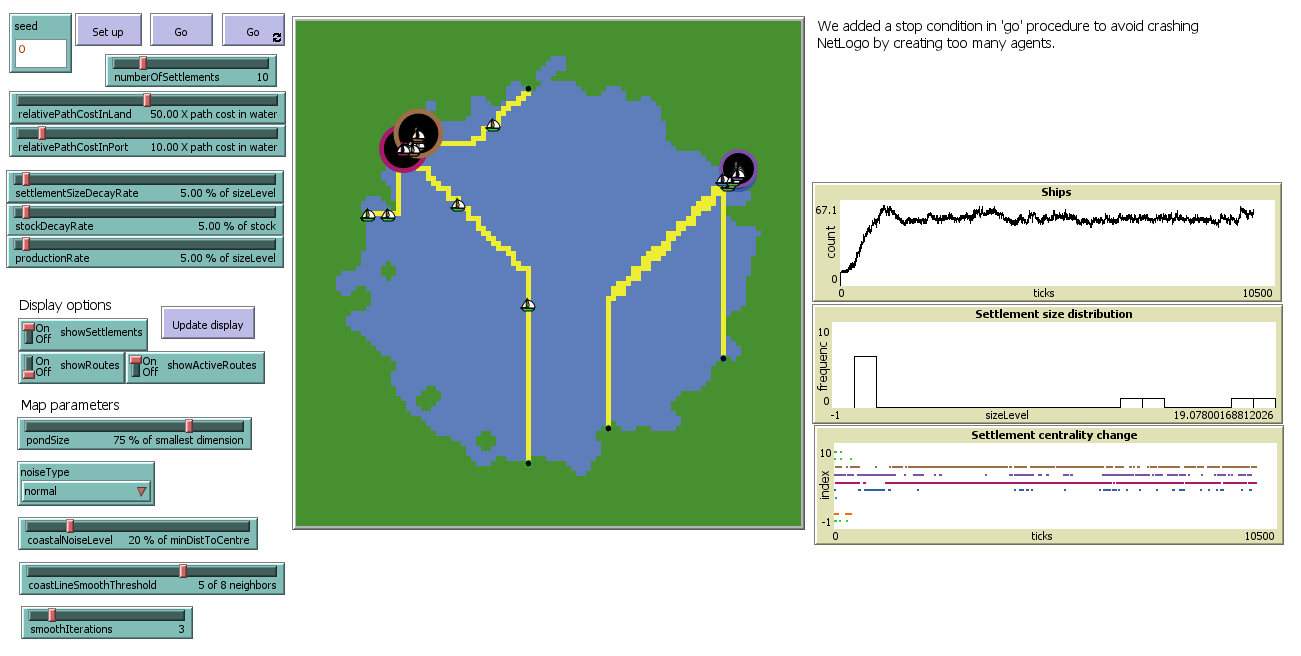
We can now observe that the number of traders in our pond oscillates around a stable low level most of the time. We can observe some exceptions by exploring higher values of numberOfSettlements. With enough settlements, our feedback loops push the dynamics towards the emergence of hubs, boosting the overall number of traders.
Pond Trade step 9
19.8 Updating the conceptual model
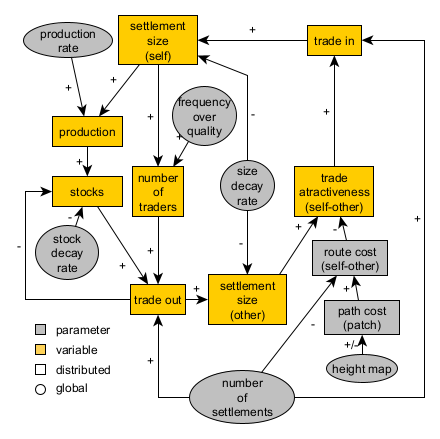
We reach the end of the implementation steps for the first-tier Pond Trade model. Given all the changes and extensions we made, we must revisit our conceptual model and update it accordingly.
Pond Trade conceptual model revised at step 9 (first tier)
This graphical description is still far from the implementation code, as it should be. However, it now adequately reflects the new conceptual changes we introduced in the code.